Medical paperwork takes time away from patient care. Clinics and healthcare businesses deal with appointment notes, referral letters, forms, summaries, and follow-up messages—often across several systems. Google’s Gemini for healthcare preview, announced with major partners already involved, reflects a growing interest in using AI to help with this administrative work.
AI can make paperwork faster, but healthcare data is sensitive and mistakes can have serious consequences. We at Best Choice help businesses assess where AI fits, connect it to existing workflows, and add the checks needed to keep people in control. The goal is not to replace professional judgement; it is to reduce repetitive work safely.
1. What AI could change in medical paperwork
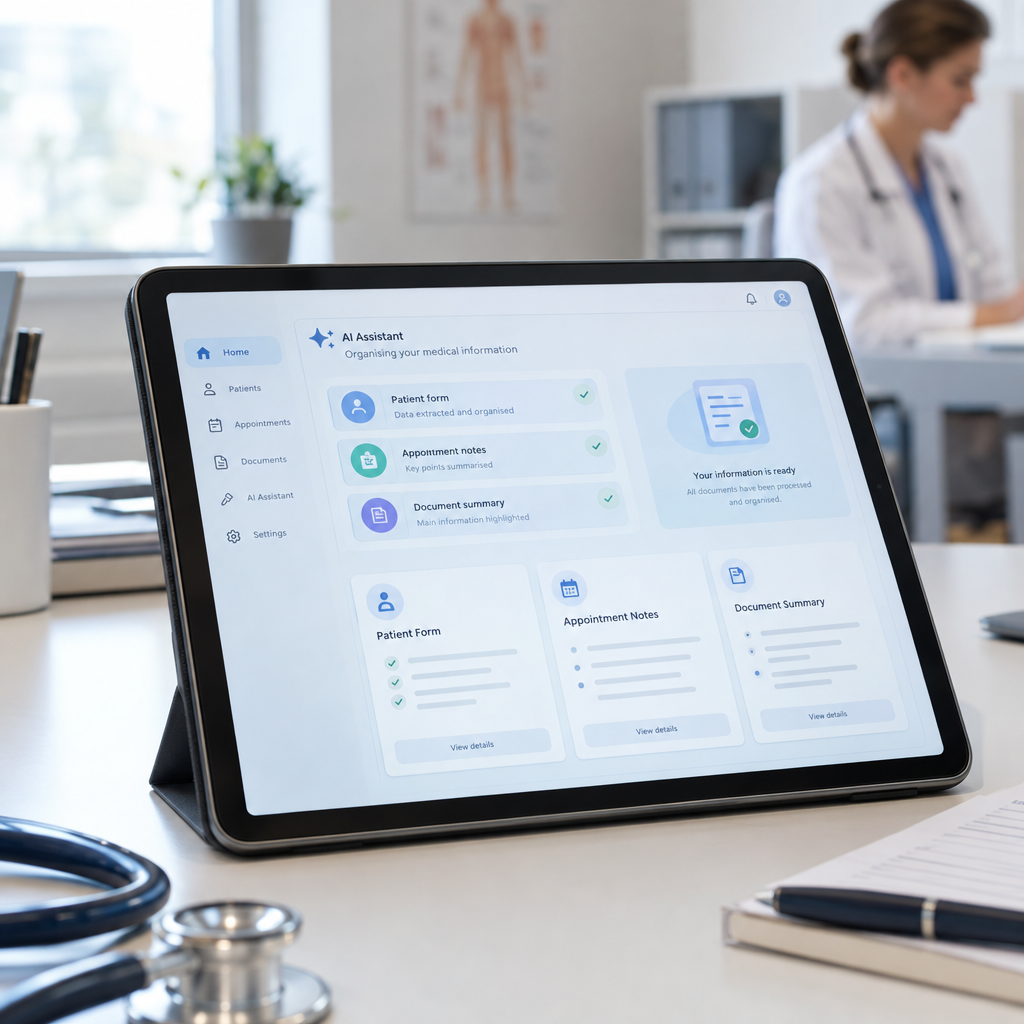
Healthcare teams produce and process a wide range of documents. An AI assistant may help organise information, draft routine text, summarise documents, or classify incoming requests, depending on the system and how it is configured.
For example, a private clinic might receive appointment requests by email, phone, and web form. A connected workflow could sort each request, prepare a draft response, and place the key details in a review queue. Staff still check the information before it is sent or added to a patient record.
2. Start with a workflow—not a chatbot
Adding a chatbot is not always the best first step. We recommend identifying one repetitive process, measuring how much time it takes, and deciding what a useful improvement would look like. That might be fewer manual data entries, faster document handling, or less time spent preparing routine correspondence.
At Best Choice, we can build a tailored workflow around your clinic’s actual process. It could collect information from a secure form, check that required fields are present, prepare a draft, and send it to an authorised employee for approval. This helps prevent a new AI tool from becoming another disconnected system.
3. Keep healthcare professionals in control
AI-generated text should be treated as a draft, not a verified medical record. A clinician or authorised staff member should review important details, correct errors, and approve content before it is used for patient care or sent externally.
Consider a physiotherapy clinic preparing follow-up notes after appointments. AI might help format information supplied by the therapist, but the therapist must confirm that the note is accurate and appropriate. Clear approval steps, edit history, and escalation rules make this process safer and more accountable.
4. Protect patient data and meet European requirements
Health information is especially sensitive under GDPR. Before using Gemini or another AI service with patient data, a business should understand what information is shared, how it is processed, where it is stored, how long it is retained, and whether it may be used to improve a service. The right answers depend on the specific product, contract, configuration, and use case.
For businesses in Denmark and across Europe, we recommend involving your data protection officer or legal adviser early. Use data minimisation, role-based access, secure integrations, and documented retention rules. Do not paste identifiable patient information into a general-purpose AI tool unless its use has been properly assessed and authorised.
5. Connect AI to the systems you already use
AI is most useful when it fits into existing operations. A healthcare business may need connections between booking software, email, document storage, billing, and a patient management system. Custom integrations can reduce duplicate entry and help ensure that information moves to the right place with appropriate checks.
We can help assess whether to connect an existing platform, improve its setup, or create a dedicated workflow. Open standards such as FHIR can support healthcare data exchange where the relevant systems offer compatible interfaces. The practical choice depends on your software, security requirements, and the task you want to automate.
6. Test carefully and measure the results
Begin with a limited pilot using a low-risk administrative task and clear success measures. Track time saved, correction rates, staff feedback, and any errors or delays. Test unusual cases as well as the standard workflow, and make it easy for employees to flag problems.
Once the process performs reliably, you can consider expanding it. A clinic might start by sorting non-urgent enquiries, then explore document preparation after reviewing privacy, accuracy, and staff workload. A measured rollout helps ensure that automation creates real value rather than simply adding another tool.
Explore a practical next step
Gemini for healthcare’s preview is a sign that AI-assisted administration is developing quickly, but every healthcare business needs to decide what is suitable for its own data, systems, and responsibilities. The strongest results usually come from a well-designed process with secure integrations and human review—not from AI alone.
We at Best Choice can help you map paperwork bottlenecks, assess integration options, and plan a safe AI or automation pilot. Contact us to discuss a solution that fits your business and supports your team.